The Hedgerows & Margins: Documenting the Wild Fringes
The hedgerows and margins are where two worlds meet. Woodlands, hedgerows, footpaths and farm tracks form the shifting boundary between cultivated land and wild nature. These liminal places are alive with birds, insects, mammals and plants, reminding us that some of the richest stories are found not at the centre of the field, but around its edges.

6 September 2026
New Wood, southern boundary
A partially constructed stick den nestled within the interior of New Wood. Probably built using fallen branches, this structure tells the story of modern day human enjoyment and quiet connection to the land. It shows how these historic Old Knebworth woodland margins continue to provide spaces for exploration, play, and community interaction.

6 September 2026
New Wood, southern boundary
The rich, layered habitat of New Wood - again showcasing the constant balance between growth and decay. A gradually rotting fallen trunk dominates the foreground floor, providing an essential ecological base for mosses and insects. Surrounded it is an understory of young sweet chestnut and mature oak trees catching the early autumn sun.

6 September 2026
New Wood entry point at southern end of eastern boundary.
As with many of my photographs of New Wood, this photo highlights the constant cycles of growth and decay within the woodland. An uprooted tree stump with its exposed root system sits amidst the autumn leaf litter under a still very much alive, green canopy.

6 September 2026
Green Lane, eastern boundary
Golden, translucent tree resin oozing from the bark of a wild cherry tree along the Green Lane track. Known naturally as gummosis, this glowing amber substance serves as the tree's defensive shield, sealing wounds and protecting the ancient boundary timber from pests and weather.

6 September 2026
Green Lane, eastern boundary
An ancient boundary tree standing along the historic path of Green Lane/Dowagers Lane. Positioned within the mature hedgerow line separating the trackway from the modern day arable field and historic grazing lawns, its heavily gnarled, massive trunk tells the story of centuries of traditional land management and worked boundaries.
6 September 2026
Hedgerow, eastern boundary
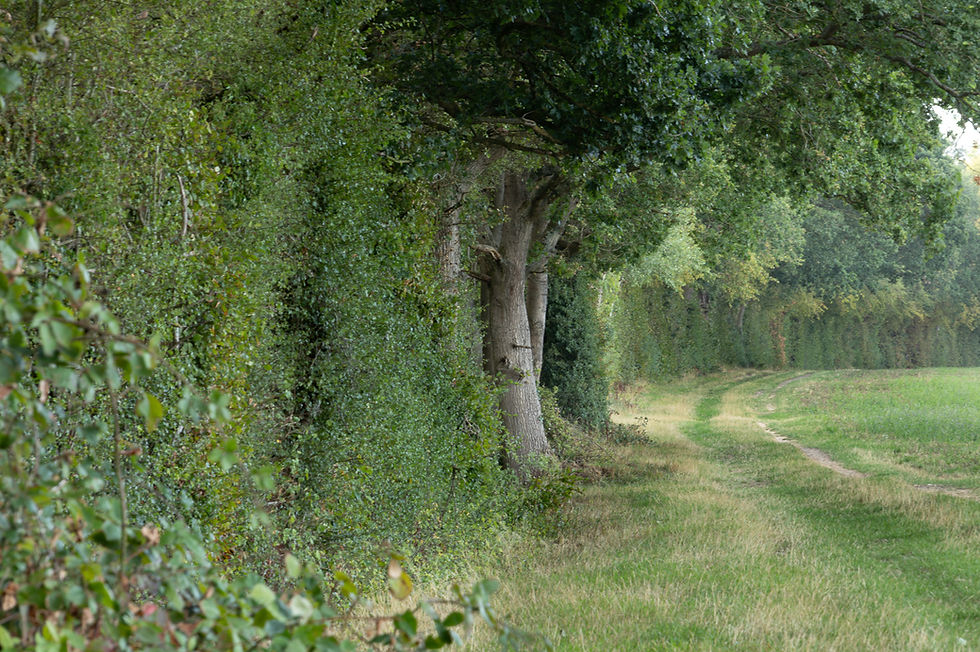
Looking south along the eastern boundary, where the ancient hedgerow meets the field margin. This perspective shows the vital unploughed grass buffer strip and worn footpath that separates the dense, historic woodland hedge from the active arable field, providing a continuous corridor for local wildlife and walkers.

6 September 2026
Hedgerow, eastern boundary
A mature English Oak stands at the threshold between the north-eastern corner of the arable field and the entry into Green Lane/Dowagers Lane. Its expansive canopy fields the boundary line, while its deep, shadowed base marks the transition from the working arable land into the dense, layered interior of the ancient woodland carting track.

6 September 2026
Hedgerow, eastern boundary.
A cluster of wild dog-rose hips ripening along the ancient eastern hedgerow boundary line. The scrambling, thorny framework of the rose provides both food and sanctuary for local wildlife. The leaves are just beginning to turn with the arrival of autumn.

22 August 2026
Hedgerow, western boundary
Mature English Ivy umbels almost ready to bloom. Within a couple of weeks, these buds will bloom into small greenish-yellow, star shaped flowers. Packed with nectar, they will produce a sweet and musky scent.

22 August 2026
Hedgerow, western boundary
A bramble leaf turning vivid red. Whist brambles are mostly evergreen, individual older leaves often turn red in the autumn as the plant reabsorbs its nutrients.

22 August 2026
Hedgerow, western boundary
The knopper gall has developed further on this oak tree. The misshapen acorn that we saw back in July is now completely unrecognisable. The gall has become thick, green, lumpy and sticky. Inside, the larvae of the gall wasp are protected. The knopper gall will fall from the oak in the autumn but will continue to protect and feed the larvae until they eat their way out of it in the spring.

22 August 2026
Hedgerow, western boundary
The fruits/nutlets on the Large-leaved lime tree are continuing to develop. Their green furry shells have now turned brown, and what was a vivid green leaf canopy just a couple of weeks ago, is now showing the first signs of the approaching autumn.

22 August 2026
Hedgerow, western boundary
A ladybird rests on a leaf within the hedgerow. Ladybirds have been particularly abundant this year across the arable field. This ladybird will have hatched over summer and will now be building its internal fat reserves ready for winter hibernation or diapause.

22 August 2026
Hedgerow, western boundary
A spiders web catches the light high in the canopy of Large-leaved lime.
22 August 2026
Hedgerow, western boundary
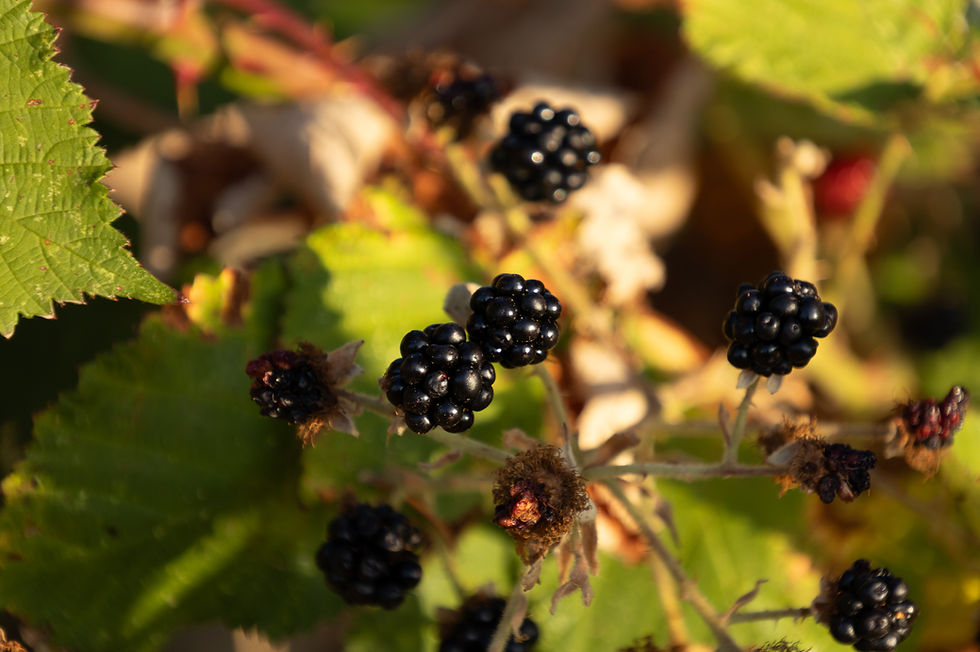
Blackberries continue to ripen, however the early ripening fruits are already starting to dry and shrivel in the summer warmth. Whilst still providing a tasty treat for birds and walkers, the fruits may well have dried long before migrating birds return to the UK for late autumn sustenance.

2 August 2026
Green Lane, eastern boundary.
From Green Lane, Park Wood appears wild and untouched, however a closer look reveals coppiced stools and multi-stemmed trees, reminders that this woodland once worked as hard as the arable field that sits nearby.

2 August 2026
Green Lane, eastern boundary.
By early August, the native Hogweed umbels that were alive with hoverflies a few weeks earlier have become intricate seed heads. Their role has changed - from feeding pollinators to feeding birds and ensuring that the next generation of plants take seed.

2 August 2026
Green Lane, eastern boundary.
The unmistakeable tight spike and scarlet berries of Lords and Ladies, a plant that thrives in ancient woodland and shady hedgerows. This plant has accumulated a huge number of folk names over the centuries. Some common names include; cuckoo pint, jack-in-the-pulpit, wake robin, devils and angels and adders meat. Historically the roots of Lords and Ladies was processed into Portland sago, a very fine starch used for stiffening collars and ruffs in Tudor and Elizabethan England.
2 August 2026
Green Lane, eastern boundary.
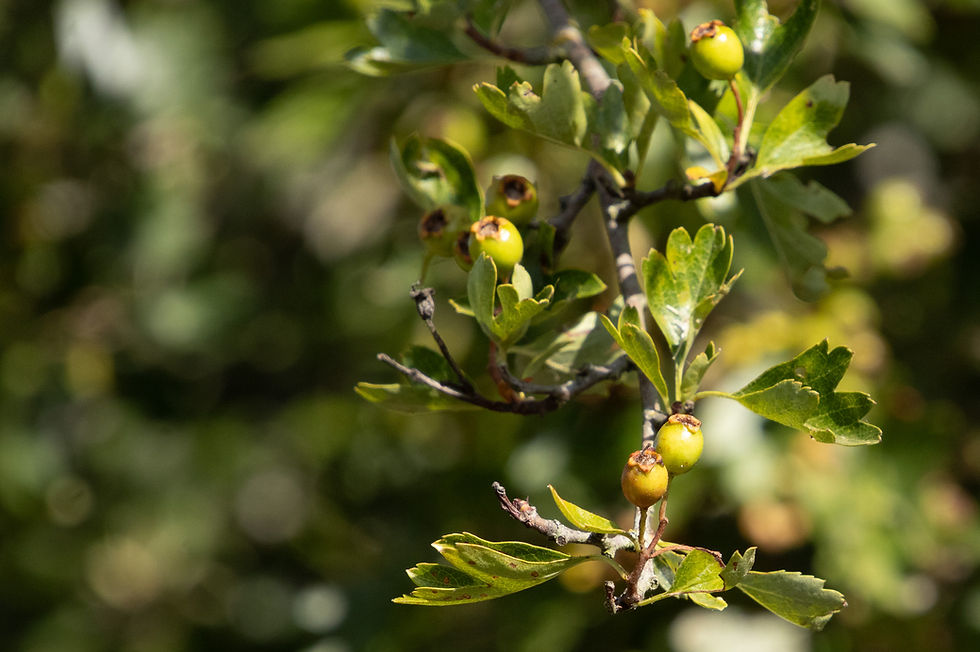
Maturing haws on a hawthorn branch, mostly green with just a hint of yellowing. Over the next few months, these haws will turn a bright scarlet. Hawthorn berries are an important native food source for many woodland bird species, such as blackbirds, thrushes, redwings, fieldfares, robins and bullfinches. Small mammals also eat any fallen fruit and the dense, thorny structure of its hedgerow provides excellent nesting cover.

2 August 2026
Green Lane, eastern boundary.
What looks like a collection of birds nests high in the beech canopy is actually something far more interesting. This tangled mass of living shoots, dead twigs and years of accumulated debris is the tree's response to an old wound. Likely a naturally occurring wound rather than one caused by historic woodland management, this mass of epicormic growth, sometimes referred to as a witches broom, has become an important ecosystem in its own right.

2 August 2026
Green Lane, eastern boundary.
The great veteran trees lining the edge of Park Wood are reminders that this woodland was once worked as well as walked. Many bear the unmistakeable forms of old pollards, their trunks swollen by centuries of repeated cutting for timber and firewood.

2 August 2026
New Wood grassy margin, southern boundary.
Rosebay willowherb nearing the end of its flowering season. Maturing seed pods can be seen along its stem, beginning to spill white cotton-like fibres that will carry its seeds on the wind. One single plant can produce tens of thousands of seeds. Rosebay willowherb is a British pioneer species, often being the first to colonise disturbed ground and recently cut areas of vegetation. Its common name, Fireweed comes from its ability to rapidly colonise burnt ground. Rosebay willowherb is an excellent source of nectar for many pollinators. The fluffy seed heads are also used as nesting material by some birds if any remains in spring.

1 August 2026
Wide grassy margin, southern boundary.
Woody shoots expanding outward into the dry buffer strip of the arable field. Rather than growing from dropped seeds, these plants are spreading via underground root suckers extending directly from the mature trees along the edge of New Wood. Likely either young elm suckers or hazel regrowth, this aggressive colonising behavior shows how historic woodland boundaries naturally attempt to reclaim open ground. It highlights the dynamic, shifting nature of the boundary between the forest and agricultural fields when left unploughed.

1 August 2026
Wide, grassy margin, southern boundary.
Young sallow shoots (wild willow) expanding into the wide grassy buffer strip between the arable field and New Wood.
The appearance of these hardy shoots highlights a deep historical connection to the land: old maps and local records reveal that New Wood was historically once known at least in part as Sallow Wood. This image provides visual evidence that the native sallows are actively reclaiming their historic boundary territory, self-seeding out from the woodland edge into the open agricultural margin.

1 August 2026
Main north-south track across the arable field.
Autumn hawkbit starts to become abundant due to the increased light that's reaching the ground following the recent harvest. Smaller and less leafy than their dandelion cousins, they thrive on disturbed and compacted ground. Depending on activity in the arable field , these hawkbits may flower though to October, providing late pollen and nectar for hoverflies, bees and butterflies.

1 August 2026
Hedgerow, western boundary.
A purple flowering creeping thistle makes the most of the disturbed soil on the margin between hedgerow and field. Due to its ability to spread quickly through creeping underground roots, its not a welcome addition to an arable field, however its one of the most valuable wildflowers in Britain for insects. Only the female plants produce seeds which are carried away from the plant on tufts of silky hairs that act like a parachute.

1 August 2026
Hedgerow, western boundary.
These two pears, previously photographed last month, have already begun to provide food for local birds and insects. When the fruit drops from the tree, it will provide food for further wildlife such as small mammals.

1 August 2026
New Wood margin, southern boundary.
A young acorn is developing on an English Oak tree. During the autumn months, the acorn will fall to the ground either to seed the next generation of oak or to become much needed food for local wildlife. In the past, acorns were one of the primary autumn food sources for pigs and the commoners would pay the estate for pannage rights to allow their pigs to forage within the woodland.

1 August 2026
Hedgerow, western boundary
Developing fruits hang from a Large-leaved lime tree. These small, green, furry fruits will eventually harden and turn brown, before being dropped from the tree in clusters which are carried on its wing like bracts.

1 August 2026
Hedgerow, western boundary.
The ripening berries of bittersweet, ready to be eaten by birds who will disperse the seeds.

1 August 2026
Hedgerow, western boundary.
Beautiful purple bittersweet flowers hanging from within the hedgerow. Also known as woody nightshade, all parts of bittersweet are highly poisonous to humans, especially the bright red berries that can be seen already formed in the picture below. Although poisonous to us, several insects feed on its flowers and many birds, particularly blackbirds and thrushes can safely eat the ripe berries. The common name of bittersweet comes from its stem. If the stem is cut and tasted (definitely not recommended) it was traditionally said to have tasted bitter at first, followed by a sweet aftertaste.

1 August 2026
Hedgerow, western boundary.
Threading its way through the nettles, white bryony uses its delicate coiled tendrils to climb towards the light. Its flowers attract bees in late summer, whilst on female plants, the berries that follow will provide food for birds. Used in some traditional medicines throughout the ages, white bryony is now recognised as a plant that's highly toxic to humans, so whilst its bright red autumn berries may appear attractive, they're best left well alone.

1 August 2026
Hedgerow, western boundary.
Small clusters of bright red Common Honeysuckle berries hidden amongst the foliage. Where the flowers would have provided food food for moths on warm summer evenings, the fruits will now feed birds, dispersing the seeds and carrying the hedgerow's story into a new generation. Because it twines so tightly around trees and hedgerow shrubs, honeysuckle became known within British folklore to symbolise devotion, enduring affection and all forms of faithful attachment.

1 August 2026
Hedgerow, western boundary.
Waiting to pop, a Common Broom seed pod dries in the sun. Eventually it will split with a loud snap, firing its seeds several metres away. Native to Britain, common broom has been part of the landscape for thousands of years. It gave its name to the Plantagenet royal dynasty. Geoffrey of Anjou was said to wear a sprig of broom (planta genista) in his helmet. Thriving on poor soils and disturbed ground, where many other shrubs struggle, broom has long symbolised renewal, humility and resilience. Traditionally bunches of broom were used as simple household brooms, hence its common name.

1 August 2026
Hedgerow, western boundary.
A white butterfly resting on a bramble leaf, wings folded for camouflage. Bramble, although often seen as an untidy tangle, provides nectar, fruit, shelter and nesting places throughout the year, underpinning much of the wildlife found along the field margins.

25 July 2026
New Wood, southern boundary.
I last photographed this split fallen branch back in January. Since then, the split has become larger as its dried out over the summer months. The wet autumn leaves that filled the cavity back in January have now broken down into soil, evidence of the many organisms at work in this mini ecosystem and a reminder that life is present even in decay.

25 July 2026
New Wood, southern boundary.
Lying across the woodland floor, this tree probably fell quite some time ago. Although no longer living in the literal sense, the tree probably now supports more life than it did when it was living. Its timber has softened into a maze of chambers and tunnels. Beetles, fungi, mosses and countless other unseen organisms now rely on the tree as a source of shelter and nutrients as it gradually decays into the woodland soils.

25 July 2026
New Wood, southern boundary.
Enchanters nightshade has reached its peak. Its developing hooked seed pods will soon cling to the fur of passing animals to be dispersed. The genus is named after the Greek sorceress Circe due its love of cool, shadowy places and its delicate, almost ethereal flowers. Recognised as an ancient woodland indicator species in many parts of the UK, including regions across the south and east. Its presence in the understory of New Wood is a great indicator of long-term ecological continuity, signaling that this ground has likely remained shaded, unploughed woodland for centuries

25 July 2026
New Wood, southern boundary.
Looking up through a canopy of a hazel tree. Its shade giving leaves are all still beautifully green but soon will be a distant memory.

25 July 2026
New Wood, southern boundary.
This in parts ancient woodland area always feel so magical to me. It's a place of contradictions. It's a place of light and dark, a place where both life and death are always present.

25 July 2026
Woodland margin, southern boundary.
The first red holly berries appear much earlier than usual. Typically, native holly berries remain green through the summer and do not ripen to red until late autumn. This unusual early colour may be an early ripening response triggered by summer heat stress, drought, or the influence of nearby garden varieties. You can see the current year's typical tiny green berries developing normally on the far right of the branch.

25 July 2026
Grassy margin, southern boundary.
Meadow Buttercups add a splash of late summer colour to the grassy margin between the arable field and New Wood. Such small and simple flowers, yet always so cheerful.

19 July 2026.
Hedgerow, western boundary.
Clusters of immature hazelnuts develop. By early autumn they will provide an important food source for birds and mammals, though many will disappear long before they ever reach the ground.

19 July 2026.
Hedgerow, western boundary.
A Red Kite sits high above the western hedgerow, surveying the field below. Once almost lost from the English countryside, the species has become a familiar presence over Hertfordshire, gliding effortlessly between woodland and farmland.

19 July 2026.
Hedgerow, western boundary.
The paired winged seeds of a sycamore begin to mature along the western hedgerow. By autumn they will detach and spin to the ground, carrying with them the possibility of a new generation forming beyond the shelter of the parent tree.

19 July 2026.
Hedgerow, western boundary.
The western boundary shelters more than just wildlife. Hidden beneath the ivy, a discarded bottle becomes another layer in the story of this landscape, where evidence of people sits alongside birds, insects, plants and mammals.

21 July 2026
Hedgerow, western boundary
A young, developing acorn appears misshapen on this oak tree. Possibly due to gall wasp larvae. If so, as time goes on the larvae will secrete growth hormones that will trick the oak tree into growing a green, sticky, protective case instead of an acorn. The case will protect and feed the larvae until it turns brown and drops from the tree in the autumn.

19 July 2026.
Hedgerow, western boundary.
A hoverfly resting on a hedgerow leaf during a warm July morning. Often mistaken for wasps, hoverflies are harmless pollinators whose larvae help control aphids, making them an important part of the arable ecosystem.

19 July 2026.
Field margin, western boundary.
The distinctive seed pods of love-in-a-mist remain long after the flowers have faded. Although an ornamental garden plant rather than a native wildflower, it has become established along the western boundary, illustrating again how neighbouring gardens have subtly shaped the character of this landscape.

19 July 2026.
Field margin, western boundary.
Bright pink Hedgerow Cranesbill flowers emerge from the increasingly tangled vegetation of the western boundary. Although easily overlooked, these late-season flowers continue to support pollinating insects as the field begins its gradual transition towards autumn.

19 July 2026.
Field margin, western boundary.
Willowherb emerges among the grasses of the western field margin By midsummer the open flowers of spring are giving way to taller, denser vegetation as the field edge reaches its seasonal peak. These often overlooked plants are among the first to colonise disturbed ground and provide nectar for insects before releasing thousands of wind-borne seeds later in the year.

19 July 2026
Hedgerow, western boundary.
Growing aloing the sunny perimeter of the arable field, the ripening fruit of the native blackthorn bush are still a dusty green and light blue color. Traditionally known as sloes, their unripe colouring is quite a contrast to the deep, frosty-purple hue they will take on ahead of the autumn foraging season.

19 July 2026
Hedgerow, western boundary.
Ripening cherry plums. Another example of cultivated landscapes merging with natural ones. Along the western boundary neighbouring gardens have gently shaped the character of the hedgerow. Trees like this blur the distinction between cultivated and wild, offering seasonal food for wildlife whilst hinting at the people who have lived alongside the field over hundreds of years. Every boundary tells two stories: one of the nature and one of those who have left their mark on it.

19 July 2026
Hedgerow, western boundary.
Not every plant along the fields edge is truly wild. The neighbouring gardens have left their mark, introducing species that have gradually become part of the hedgerow. Here, ripening pears hint at that shared history, where cultivated landscapes slowly merge with more natural ones until the boundary between them becomes difficult to define.

19 July 2026.
Hedgerow, western boundary.
The western boundary is a meeting of two landscapes. To the left lies the harvested field; to the right a dense fringe of shrubs and trees. Between them sits a narrow strip of rough grass that acts as a corridor for wildlife and walkers, softening the boundary between the cultivated and uncultivated.

19 July 2026.
Hedgerow, northern boundary.
The first blackberries mark the gradual transition from summer to autumn. The fruit attracts birds, mammals and insects. The bramble itself is one of the hedgerows most valuable plants providing food, shelter and protection throughout the year. The blackberries are ripening early this year - I wouldn't expect to see them for another 6 weeks.

19 July 2026.
Hedgerow, northern boundary.
Forming part of the northern boundary of the field, this clipped yew hedge separates neighbouring houses from the public footpath and arable landscape beyond. Despite its cultivated appearance, it provides year round shelter for birds, insects and spiders. Delicate sheet webs are visible between the branches, full of the remains of recent trappings.

24 May 2026.
Hedgerow, northern boundary.
A narrow footpath follows the northern boundary of the field, bordered by oilseed rape on one side and a mature garden hedge on the other. Between them lies a grassy margin that softens the transition between agriculture, wildlife and neighbouring homes.

14 April 2026.
Woodland margin, southern boundary.
Dew drops drying on a Garlic Mustard, as the April sun encourages its buds to open. Garlic Mustard plays an important role in the landscape, providing nectar for early pollinators and serving as the primary food source of the Orange-tip butterfly.

13 April 2026.
Grassy margin, northern boundary.
Common Field-speedwell often goes unnoticed amongst the grasses of field margins. Flowering from late winter through much of the year, it provides a source of early nectar for pollinating insects.

28 January 2026.
New Wood, southern boundary.
What first appears to be the death of a tree is just the beginning of a new cycle. Moss softens the bark. Fungi break down the timber. Fallen leaves gather in the hollow and slowly become soil. Even after death, the tree continues to shape the woodland, providing shelter, food and habitat.

28 January 2026
New Wood, southern boundary.
Beneath the fallen leaves, a carpet of moss spreads across the woodland floor. It holds moisture, shelters insects and helps return nutrients back to the soil.

28 January 2026.
New Wood, southern boundary.
What appears to be decay is actually renewal. Bracket fungi are returning the dead wood to the woodland, releasing nutrients that will feed the next generation. Even in death, the fallen branch remains full of life.

28 January 2026.
New Wood, southern boundary.
Bluebells start to appear through the deciduous leaf litter on the woodland floor. A sign of the coming spring.

28 January 2026.
The southern boundary, woodland margin.
This is a place of transitions. Arable becomes grassy. Grassy becomes hedgerow. Hedgerow becomes woodland. The frost is melting on this European beech. An opened and vacant cupule still clings on, a remnant of last years bounty. New leaves are forming within tightly closed buds. This is a story of 3 seasons. The attached cupule speaks to last autumn, the melting frost highlights the still very present winter, and the budding leaves look forward to the coming spring.